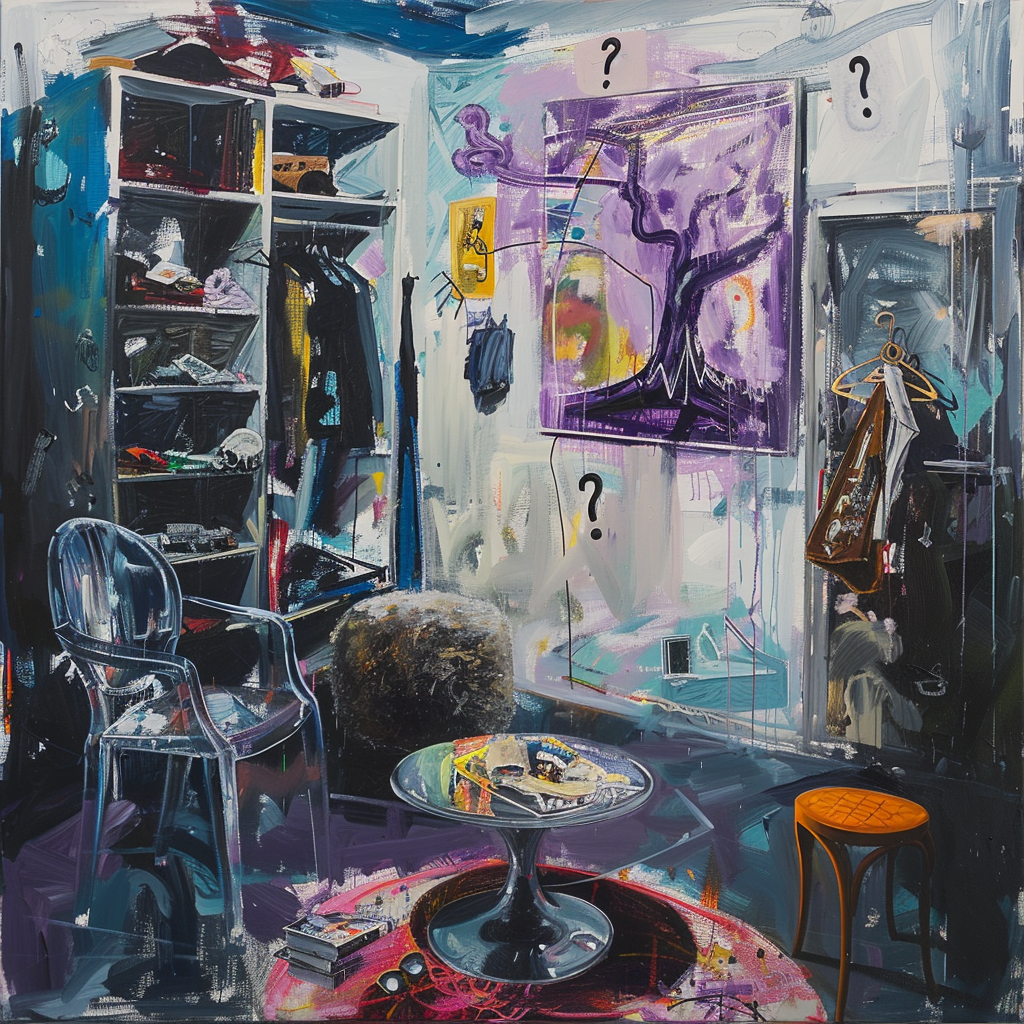
I do not understand anything I see.
Welk persoon of welke situatie ontneemt je momenteel je vrede? Vul het hieronder in voor een persoonlijke reflectie op basis van deze les.
Lesson 3: “I do not understand anything I see in this room [on this street, from this window, in this place].”
This lesson is very gentle, but it touches something deep. It invites you to admit something the ego never wants to admit: “I don’t understand.”
The ego survives by pretending it knows what everything is, what it means, and what it’s for. The Holy Spirit begins your healing by loosening that false certainty. Lesson 3 is the beginning of humility—not humiliation, but the soft, open humility that says: “Maybe I’ve been wrong about everything. And maybe that’s good news.”
I. The Core Teaching
1. What this lesson really says
On the surface, Lesson 3 asks you to look around and say:
“I do not understand this table.”
“I do not understand this hand.”
“I do not understand this body.”
“I do not understand this door.”
It sounds almost silly at first. Of course you “understand” a table, a hand, a door. But the Course is not talking about practical understanding. It is talking about *meaning and purpose*.
You think you know what things are for:
- This body is for survival, pleasure, defense.
- This relationship is for getting love, security, validation.
- This job is for money, status, safety.
- This illness is punishment, bad luck, or proof that you’re vulnerable.
The Course gently says:
You do not understand anything you see, because you have given it a meaning that is not true. You have made up a world to support the ego’s story of separation, fear, guilt, and death. You see what you believe, not what is there.
2. What is the ego trying to hide?
The ego’s core belief is: “I am separate from God and from everyone else.” This belief is unbearably painful, so the ego builds a dense world of meanings to distract you:
- “This person hurt me.” (So I’m a victim.)
- “This person saved me.” (So I’m dependent.)
- “My worth comes from my body, my work, my status.” (So I must constantly prove myself.)
- “The world is dangerous, and I must defend myself.” (So fear is justified.)
The ego uses *interpretation* to keep you from questioning its basic story. It doesn’t want you to pause and say, “Maybe I don’t know what this means.” Because the moment you question the meaning the ego has given, a little light enters.
The ego is trying to hide:
- That the world you see is a projection of your own mind.
- That your judgments are not facts, but choices.
- That your suffering is not being *done to you* but is being *chosen* at some deeper level to maintain separation.
- That beneath all this is a Love so vast that if you remembered it, the ego would disappear.
3. What is the Holy Spirit revealing?
The Holy Spirit is the Voice for Love and sanity in your mind. It does not attack the ego; it simply offers a different way of seeing.
By asking you to say, “I do not understand anything I see,” the Holy Spirit is opening a space where *true meaning* can enter.
The Holy Spirit wants to reveal:
- That everything you see can serve a holy purpose: forgiveness, healing, joining.
- That nothing in this world can change your true Identity as God’s innocent Child.
- That every situation is either an expression of love or a call for love.
- That what you think is attack, loss, or punishment can be reinterpreted as an opportunity to remember your invulnerability.
You are not asked to understand this all at once. You are only asked to admit:
“Maybe my way of seeing has been wrong. I am willing to be shown another way.”
Lesson 3 is that soft opening.
II. Applied to Daily Life
Let’s bring this into the places where it matters most: relationships, work, illness, anxiety, and daily stress.
1. Relationships
Suppose someone you love is distant or critical. The ego quickly interprets:
- “They don’t care about me.”
- “I’m not good enough.”
- “I need to defend myself or withdraw.”
Lesson 3 invites you to pause:
- “I do not understand this person.”
- “I do not understand this situation.”
- “I do not understand what this relationship is for.”
You are not denying what seems to be happening. You are simply refusing to lock it in with your old meanings. This creates space for the Holy Spirit to reinterpret:
- Maybe this is a mirror of your own self-criticism.
- Maybe it is a chance to practice non-defense.
- Maybe it is an invitation to communicate honestly and kindly.
- Maybe it is a call for love—from them, from you, or both.
By admitting you don’t understand, you become willing to see with new eyes.
2. Work and career
At work, you may feel pressure, competition, or fear of failure. The ego says:
- “My job proves my worth.”
- “If I lose this, I lose everything.”
- “These people are obstacles or threats.”
Lesson 3 invites:
- “I do not understand this job.”
- “I do not understand this coworker.”
- “I do not understand what my work is really for.”
From the Holy Spirit’s perspective, your job is a classroom:
- A place to learn cooperation instead of competition.
- A place to practice honesty, kindness, and inner peace.
- A place to remember that your worth is given by God, not by performance.
You don’t have to figure out the holy purpose. Just admit you don’t know, and be willing to be shown.
3. Illness and pain
Illness often brings fear, anger, or guilt. The ego’s meanings:
- “I am being punished.”
- “I am weak and vulnerable.”
- “My body is who I am, and my body is failing.”
Lesson 3 suggests:
- “I do not understand this illness.”
- “I do not understand this pain.”
- “I do not understand what this is for.”
This doesn’t mean you deny symptoms or avoid treatment. It means you question the story around them. The Holy Spirit can then reveal:
- This can be a time of deepening trust.
- This can soften your heart toward others who suffer.
- This can help you detach your identity from the body and remember your mind’s power.
The body’s condition does not define your Self. You are learning to see beyond appearances.
4. Anxiety and daily stress
When you feel anxious—about money, the future, relationships—the ego insists:
- “I know what’s going to happen, and it will be bad.”
- “I must control everything.”
- “I’m alone in this.”
Lesson 3 interrupts this cycle:
- “I do not understand this fear.”
- “I do not understand this situation.”
- “I do not understand what anything is for.”
This cracks the shell of certainty around your fear. Into that crack, the Holy Spirit can whisper:
- “You are not alone.”
- “You are cared for in ways you do not yet see.”
- “Your safety does not depend on circumstances.”
You don’t have to force yourself to believe this yet. You only need to admit: “Maybe my fear is not telling me the truth.”
III. Overcoming Resistance
1. Why this lesson may feel uncomfortable
This lesson can feel threatening because the ego equates “I don’t understand” with:
- “I’m stupid.”
- “I’m unsafe.”
- “I’m out of control.”
The ego survives through control. It wants to label, judge, and categorize everything. To say “I do not understand anything I see” feels like stepping into emptiness.
But this is not an emptiness of loss. It is an emptiness of *space*—space for a new Teacher, a new meaning, a new experience of peace.
2. Gently addressing doubts and fear
You might think:
- “If I admit I don’t understand, won’t I be taken advantage of?”
- “If I don’t trust my interpretations, how will I function?”
- “Isn’t this just denial?”
The Course is not asking you to stop using common sense. You still lock your door, pay your bills, go to work, take your medicine. The change is *internal*: you stop worshiping your interpretations as truth.
You can think of it this way:
- On the level of form, you still act responsibly.
- On the level of meaning, you become humble and open.
You can say to yourself:
“I will continue to do what seems practical here,
but I will not insist that my interpretation is the truth.
I am willing to be shown a kinder way of seeing this.”
This is all that is asked.
IV. Today’s Practice
Here is a simple way to practice Lesson 3 today, in line with the Workbook’s instructions.
1. Short practice periods
- Do 3–4 short practice periods today, about one minute each.
- Sit quietly, look slowly around you.
- As your eyes rest on each object, say gently:
- “I do not understand this [chair].”
- “I do not understand this [hand].”
- “I do not understand this [window].”
- Include things near and far, big and small, familiar and unfamiliar.
Let the words sink in. You are not forcing yourself to feel anything. You are simply stating a fact: you do not truly understand the real meaning or purpose of anything you see.
2. Bringing it into your day
Whenever you feel upset, triggered, or anxious, pause for a few seconds and say silently:
- “I do not understand this situation.”
- “I do not understand what this is for.”
Then add, if you like:
- “Holy Spirit, if there is another way to see this, please show me.”
You don’t have to hear an answer right away. The willingness itself is the shift.
V. Comparable ACIM Lessons
Lesson 3 is part of a gentle sequence:
- **Lesson 1: “Nothing I see means anything.”**
Begins by loosening your grip on meaning altogether.
- **Lesson 2: “I have given everything I see all the meaning that it has for me.”**
Shows that the meanings you see are your own projections.
- **Lesson 3: “I do not understand anything I see.”**
Admits that your meanings are not true understanding.
Soon you will meet:
- **Lesson 5: “I am never upset for the reason I think.”**
Extends this idea into your emotional life: your interpretations about why you’re upset are also mistaken.
- **Lesson 7: “I see only the past.”**
Explains why your understanding is so limited: you are not seeing the present at all, only your past judgments.
- **Lesson 10: “My thoughts do not mean anything.”**
Goes deeper into the unreliability of the ego’s thought system.
All these lessons work together to clear a space in your mind, so the Holy Spirit can gently replace fear-based perception with true vision.
VI. Closing Thought
You are not being asked to give up truth today. You are being asked to give up your certainty about illusions.
Let today be a day of soft honesty:
“I do not understand anything I see. And that is good news, because it means there is so much more Love here than I have allowed myself to see.”
Into that humble admission, the Holy Spirit can quietly enter and begin to show you a different world.