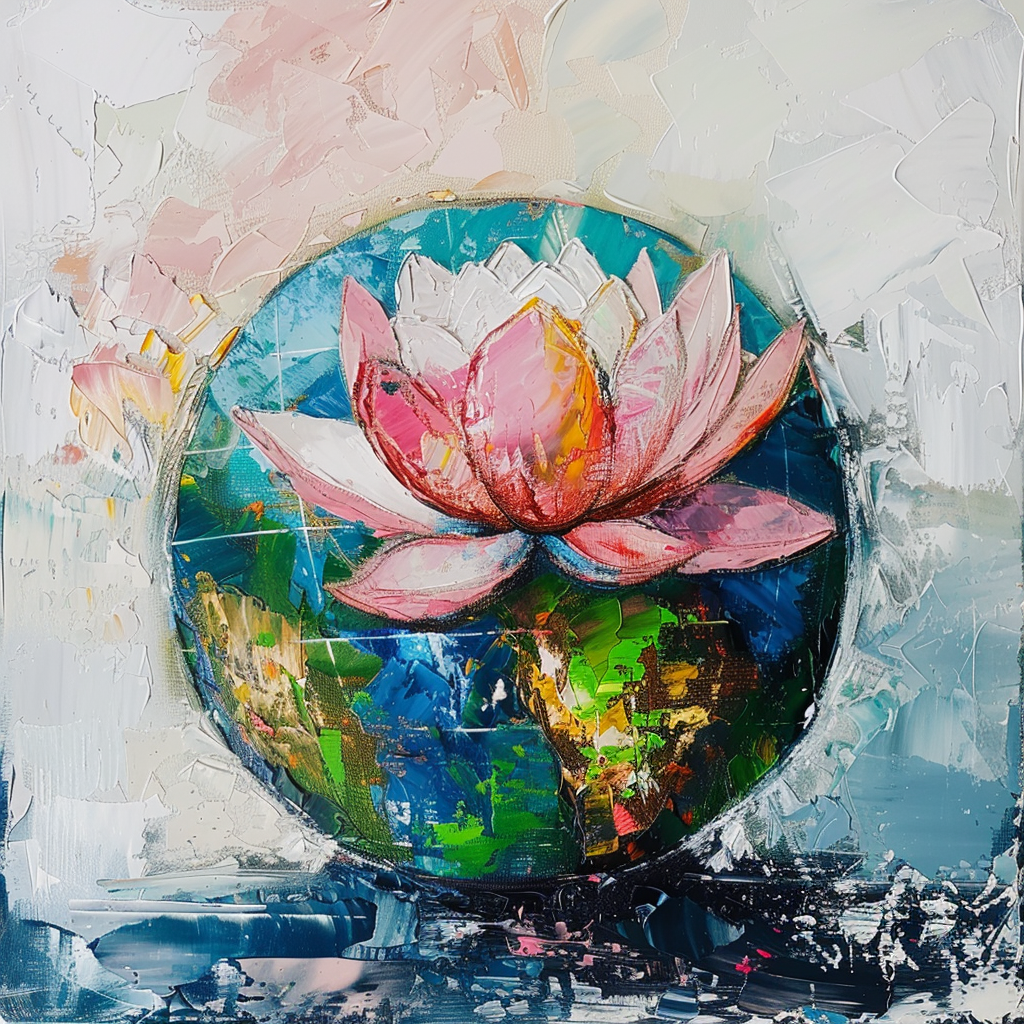
I bless the world because I bless myself.
Welk persoon of welke situatie ontneemt je momenteel je vrede? Vul het hieronder in voor een persoonlijke reflectie op basis van deze les.
Lesson 187: “I bless the world because I bless myself.”
The Core Teaching
This lesson rests on a central idea of A Course in Miracles: there is only one mind. What you give, you give to yourself. What you withhold, you withhold from yourself. What you bless, you bless within your own mind.
The ego’s entire thought system depends on the belief that we are separate: separate bodies, separate interests, separate minds, competing for limited love, safety, and resources. From this belief, the ego concludes:
- If I give, I lose.
- If I bless you, I might end up with less.
- If I forgive you, I might be taken advantage of.
- If I wish you well, who will protect me?
Underneath all this is a quiet, hidden fear:
“If I am truly joined with you, then my special, separate self is not real. And if my separate self is not real, then everything I’ve built my identity on is threatened.”
So the ego tries to hide the fact that giving and receiving are the same. It wants us to believe that what we give leaves us and goes somewhere else, so that we will cling, defend, and withhold. It wants us to believe that blessing you is a kind of sacrifice, and that to be safe, we must be careful, suspicious, and self-protective.
The Holy Spirit reveals the opposite:
- There is only one Son of God, appearing as many.
- Every mind is joined.
- Every loving thought you extend strengthens love in your own mind.
- Every blessing you give is a blessing you allow yourself to receive.
When the lesson says, “I bless the world because I bless myself,” it is not talking about a selfish blessing, as though you bless others so you can get something back. It is pointing to a fact of how mind works: you cannot think a loving thought about another without experiencing that love in yourself first. You cannot sincerely wish peace for someone without opening to peace in your own mind.
So metaphysically, this lesson is saying:
- There is only one Self.
- To bless is to recognize the holiness of that one Self.
- When you bless the world, you are recognizing your own holiness everywhere.
- When you withhold blessing, you are denying your own holiness.
The ego is trying to hide the unity of minds, because if you truly accept that what you give is what you receive, the ego’s entire strategy of defense, attack, and scarcity collapses. The Holy Spirit is revealing that your safety, joy, and peace lie in giving, extending, and blessing, because that is how you remember what you are.
Applied to Daily Life
Let’s bring this into very ordinary situations.
Relationships
Imagine you’re upset with a partner, friend, or family member. The ego says:
- “They hurt me. They’re wrong. I need to protect myself.”
You might withhold affection, give the silent treatment, or mentally attack them.
From the Course’s perspective, every unloving thought you hold about them is a thought you are holding in your own mind. You feel the tension, the tightness, the heaviness. You are the one suffering from your judgment.
To bless in this context might look like:
- Silently saying, “I bless you. I want peace for you and for me.”
- Asking the Holy Spirit, “Help me see this person as You see them.”
- Being willing to see their innocence beneath their mistakes.
You are not blessing their behavior; you are blessing the truth of what they are. And as you do, you feel a softening in yourself. The blessing you extend is the blessing you receive.
Work and Career
At work, the ego’s script is often competition, comparison, and fear of not being enough. It says:
- “If they succeed, I lose.”
- “If I help them, they might get ahead of me.”
- “I must protect my position.”
To bless the world at work might look like:
- Rejoicing in a colleague’s success: “May they be happy; their gain is not my loss.”
- Sharing knowledge instead of hoarding it.
- Silently blessing everyone in a meeting: “May we all be guided to what is truly helpful.”
As you bless, you notice your own anxiety easing. You feel more spacious, less threatened. You discover that your true security does not come from status or recognition, but from aligning with love.
Illness and the Body
When the body is sick or in pain, the ego often uses it to prove:
- “I am vulnerable. I am a body. I am at the mercy of the world.”
Blessing in this context is not pretending the pain isn’t there or denying medical care. It is a shift in how you hold the experience in your mind.
You might say:
- “This body is not what I am. I bless my mind with peace.”
- “I bless every person involved in my care. May we all be guided.”
- “I bless this situation as an opportunity to remember I am more than a body.”
As you bless, you may still take medicine, see doctors, and rest. But you do it from a gentler, more trusting place. You are not fighting reality; you are allowing love to enter your perception of it.
Anxiety and Daily Stress
When you feel anxious about money, time, or responsibilities, the ego says:
- “You’re alone. You must figure this out. There’s not enough.”
To bless the world in the midst of anxiety is to pause and say:
- “I bless this day. I bless everyone I will meet. I bless myself.”
- “I am willing to see this situation through the eyes of peace.”
- “May all who feel anxious today be comforted, including me.”
As you extend this blessing, you gently step out of the private prison of “my” anxiety and into a shared field of compassion. You remember you are not isolated. The very act of blessing loosens the grip of fear.
Overcoming Resistance
This lesson can feel difficult because it challenges the ego’s core beliefs.
1. *Fear of sacrifice*
You may think, “If I bless others, I’ll be taken advantage of,” or “If I wish others well, I’ll be left behind.”
The Course is not asking you to ignore your boundaries or stay in harmful situations. It is asking you to change your mind, not your common sense. You can leave a situation and still bless everyone involved.
2. *Fear of losing specialness*
The ego wants to be special—more deserving, more right, more victimized, more important. To bless everyone equally feels like a loss of uniqueness.
In truth, what you lose is only the burden of comparison and competition. What you gain is a deep sense of shared worth.
3. *Distrust of love*
Many of us have learned that love is dangerous, conditional, or unreliable. So when the Course invites us to bless, something in us tightens: “If I open my heart, I’ll be hurt.”
The Holy Spirit is not asking you to trust people’s egos; He is asking you to trust the Love that lives in you, which cannot be harmed by anyone’s behavior.
4. *Feeling inauthentic*
You might think, “I don’t feel like blessing them. It would be fake.”
The Course never asks you to lie to yourself. It asks for willingness. You can say, “I don’t feel loving right now, but I am willing to be shown another way. Holy Spirit, bless them for me.” Your honesty is part of the healing.
Today’s Practice
Here is a simple way to practice Lesson 187 throughout the day.
1. Morning Quiet Time (5–15 minutes)
- Sit comfortably and close your eyes.
- Gently repeat:
“I bless the world because I bless myself.”
- Let the words sink in. Imagine light in your heart, expanding gently.
- Say inwardly:
“Every blessing I give, I receive. Every loving thought I extend strengthens love in me.”
- Bring to mind a person you care about. Silently say:
“I bless you. May you know peace, safety, and joy.”
Notice how it feels in you to offer this.
- Then bring to mind someone neutral. Offer the same blessing.
- Finally, if you feel ready, bring to mind someone you struggle with. Say, even if only a little:
“I am willing to bless you. Holy Spirit, bless you through me.”
- End with:
“I bless the world because I bless myself. We are one in God.”
2. Hourly (or Frequent) Reminders
As often as you remember, pause for a moment and say silently:
- “I bless the world because I bless myself.”
- Let your eyes rest on whoever or whatever is in front of you—a person, an object, a street, a room—and quietly bless it:
“I bless you with peace.”
This is not about forcing a feeling; it is about training the mind to extend instead of contract.
3. In Difficult Moments
When you feel anger, fear, or stress:
1. Pause and take a slow breath.
2. Acknowledge honestly: “I feel upset.”
3. Then say:
“I am willing to see this differently. I bless this situation. I bless everyone involved, including myself.”
4. Ask: “Holy Spirit, show me how to bless here. Show me what to say or not say, what to do or not do.”
You may not feel peaceful immediately, but you have opened the door. That is all that is asked.
4. Evening Reflection
Before sleep, gently review your day:
- Where did I remember to bless? How did that feel?
- Where did I withhold blessing and choose judgment instead?
Then say:
- “I place this day in Your hands. I bless everyone I met, and I bless myself. Let all errors be undone in the light of Your love.”
Comparable ACIM Lessons
Several lessons echo and support Lesson 187:
- **Lesson 108: “To give and to receive are one in truth.”**
This is the foundation of today’s idea. Blessing is giving, and because minds are joined, it is also receiving.
- **Lesson 126: “All that I give is given to myself.”**
This lesson explains that every gift of forgiveness or love returns to you because there is only one mind.
- **Lesson 137: “When I am healed I am not healed alone.”**
Healing is shared. As you bless, you participate in the healing of the whole Sonship.
- **Lesson 188: “The peace of God is shining in me now.”**
Right after 187, this lesson reminds you that the blessing you offer the world comes from the light already in you.
- **Lesson 121: “Forgiveness is the key to happiness.”**
Forgiveness is a form of blessing. When you forgive, you are blessing the world and yourself simultaneously.
Closing Thought
Each time you choose to bless instead of judge, you take a small, holy step out of isolation and into shared innocence. You do not have to do this perfectly. You only need to be willing, again and again, to let love extend through you.
Today, let your quiet intention be simple:
“May I be a channel of blessing. As I bless the world, I remember who I am.”