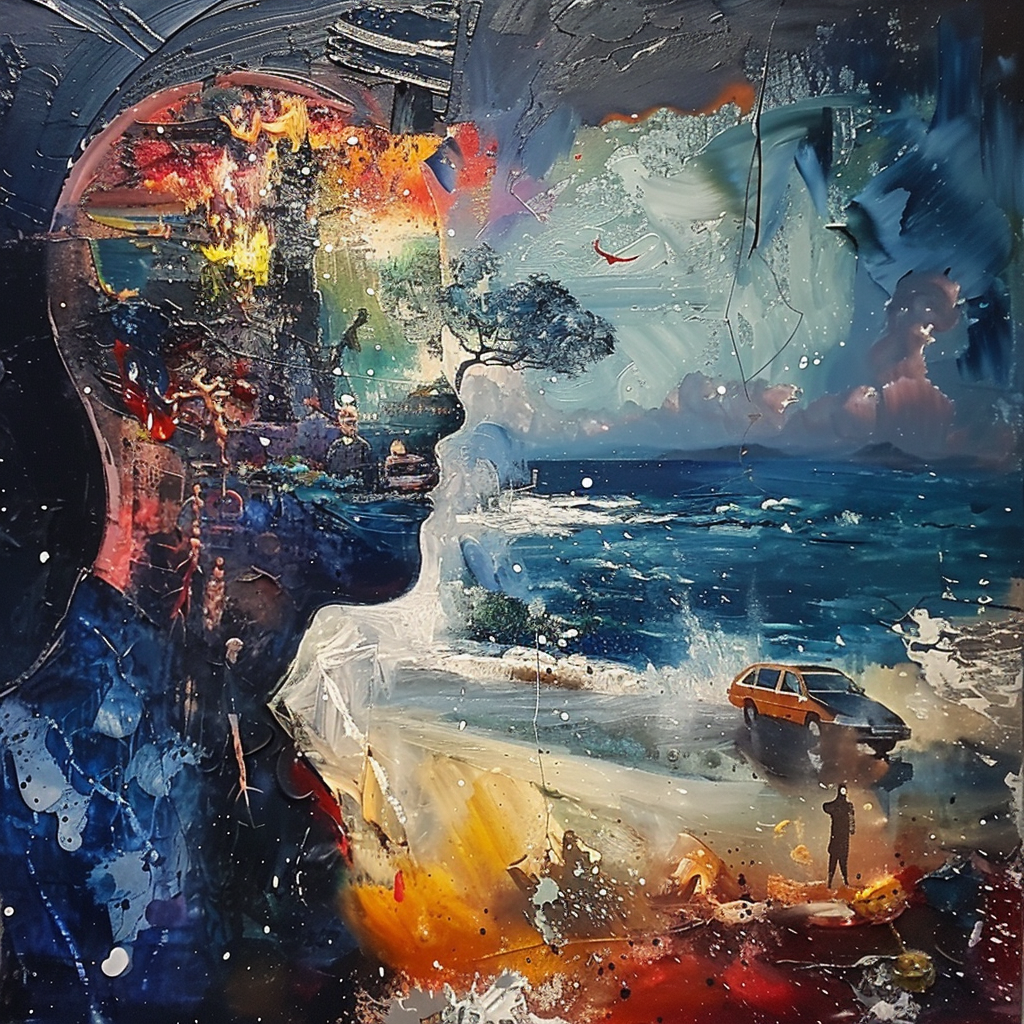
My thoughts are images that I have made.
Welk persoon of welke situatie ontneemt je momenteel je vrede? Vul het hieronder in voor een persoonlijke reflectie op basis van deze les.
*ACIM Lesson 15: “My thoughts are images that I have made.”*
Lesson 15 is a gentle but radical invitation to look at the power of your mind. It tells you that what you think is not just passing through your head like clouds in the sky. Your thoughts are making images—they are shaping the world you seem to see.
This lesson doesn’t mean you are personally, as a body, designing every detail of the world. It means that the sleeping mind that believes it is separate from God has projected a whole world of images to make separation seem real. You are being invited to notice that what you see is not “just there.” It is a movie produced by the thoughts you have chosen to believe.
1. The Core Teaching
“My thoughts are images that I have made.”
The Course is not saying that your thoughts create reality in Heaven. Reality in Heaven is created by God and is changeless, eternal Love. Your thoughts do not alter that.
Instead, the Course is talking about the world of perception—the world of time, space, bodies, conflict and death. This world is not God’s creation. It is a projection of the ego’s thought system. The ego says:
- “I am separate from God.”
- “I am a body, vulnerable and alone.”
- “I must defend myself to survive.”
- “Love is dangerous; I must control or protect myself.”
These beliefs generate images—a world that reflects them. Not as punishment, but as a mirror. The world you see shows you what you secretly believe about yourself.
So when the lesson says, “My thoughts are images that I have made,” it is reminding you:
- The world you see is not neutral.
- It is a picture of your beliefs.
- It is a classroom, not a prison.
What is the ego trying to hide?
The ego’s main goal is to keep you from discovering that:
1. *You are the dreamer, not the victim of the dream.*
If you realize you are the dreamer, you can choose a different dream. The ego wants you to believe you are trapped in the world, powerless, at the mercy of circumstances and other people.
2. *You are not a body.*
The ego wants you to identify completely with the body: its pleasures, its pains, its aging, its fragility. If you are a body, then separation and death are real. If you are mind, then you can awaken.
3. *You are not guilty.*
The ego is built on guilt. It whispers that you have broken away from God, ruined everything, and must now hide in fear. The world of images is a hiding place, a distraction from this imagined guilt.
So the ego uses the world to say:
“Look out there. The problem is outside you. You are a victim, not the cause. You are innocent because you are helpless.”
But this “innocence” is actually imprisonment, because it denies your power as mind.
What is the Holy Spirit revealing?
The Holy Spirit uses the same world for a different purpose. He gently teaches:
- “You are not a victim of the world you see.” (Lesson 31)
- “I have given everything I see all the meaning that it has for me.” (Lesson 2)
- “My thoughts are images that I have made.” (Lesson 15)
He is revealing:
1. *You are cause, not effect.*
Not as a body in time, but as mind. You are the one who chose the thought system that paints the world. When you change your mind, your experience of the world changes.
2. *The world is a mirror, not a fact.*
It shows you what you believe so you can bring those beliefs to the light and let them be undone.
3. *You can choose again.*
Every upsetting image—every scene of conflict, lack, illness, or fear—is an opportunity to say:
“Holy Spirit, show me what thought made this image. Help me see it differently.”
The Holy Spirit is not interested in fixing the images as much as in healing the mind that made them. As that mind is healed, the images soften, become kinder, or lose their power to frighten you.
2. Applied to Daily Life
Let’s look at how this plays out in ordinary situations.
Relationships
Suppose a friend doesn’t return your message. The ego’s thoughts might be:
- “They don’t care about me.”
- “I’m always the one who reaches out.”
- “People always abandon me.”
These thoughts generate emotional images: being rejected, unloved, left out. You then “see” a world in which people are cold and unreliable. The thought came first; the image followed.
Practicing Lesson 15, you might pause and say:
- “These feelings of rejection are images made by my thoughts.”
- “I am not seeing the truth; I am seeing my own fear of being unworthy.”
You then ask the Holy Spirit:
- “Show me another way to see this. What if I am loved and safe, regardless of how this person behaves?”
You may still prefer a response from your friend, but your peace no longer depends on it.
Work
At work, you may think:
- “I’m under pressure.”
- “I’m not good enough.”
- “I might lose my job.”
These thoughts become images: a harsh boss, impossible deadlines, a threatening future. The world seems to confirm your fear.
With Lesson 15, you begin to realize:
- “This sense of threat is an image made by my belief in lack and unworthiness.”
- “The Holy Spirit can show me that my real security is in God, not in this job.”
You still do your work responsibly, but you bring your fear to the light. You are no longer entirely convinced by the story of danger.
Illness
When the body is sick, the ego uses it as proof:
- “See? You are a body. You are weak. You are at the mercy of the world.”
Your thoughts then paint images of decline, loss, and death. The fear can be intense.
Applying this lesson does not mean you deny symptoms or refuse help. It means you remember:
- “This sickness is an image that reflects a belief in vulnerability and separation.”
- “My true Self cannot be sick. I am as God created me.”
You take whatever practical steps are loving and sensible, but you also use the situation as a classroom in trusting that your identity is not this body.
Anxiety and Daily Stress
Traffic, bills, deadlines, family responsibilities—these can all trigger anxious thoughts:
- “I can’t handle this.”
- “Something bad is going to happen.”
- “I’m alone in this.”
These thoughts create a world of pressure and threat. The stress feels like it is “out there,” but it began as a belief in here.
With Lesson 15, you pause and say:
- “These images of stress and danger are made by my thoughts.”
- “Holy Spirit, help me remember that I am carried, not abandoned.”
You may still have many tasks, but they are no longer proof of your unworthiness or isolation. They become neutral events in a day held by a loving Presence.
3. Overcoming Resistance
This lesson can feel unsettling. Several fears may arise:
1. *“Are you saying I caused all this suffering?”*
The ego quickly turns this teaching into guilt. But the Course is not blaming you; it is empowering you. It says, in effect:
“You are not a helpless victim. You have the power to choose again.”
The mind that made the images is not your true Self; it is a sleeping, confused part of the mind. The Holy Spirit is here to gently wake it up, not to condemn it.
2. *Fear of losing control.*
If your thoughts make images, then giving your thoughts to the Holy Spirit can feel like losing control. The ego says, “If I don’t manage everything, I’ll be destroyed.”
But notice: has your attempt to control everything brought you peace? The Holy Spirit is not taking anything real away; He is lifting the burden of fear.
3. *Fear of losing the world you know.*
Even a painful world is familiar. The idea that it is all a dream of separation can feel like too much. You might think, “If this isn’t real, what can I trust?”
The Course answers: you can trust Love. You can trust the quiet, gentle Presence in your mind that never attacks, never shames, and always leads you toward peace.
If this lesson feels heavy, go slowly. You don’t have to fully believe it yet. Just be willing to consider:
- “Maybe my thoughts are more powerful than I realized.”
- “Maybe what I see is not the whole truth.”
- “Maybe I am safer than I think.”
Willingness, not perfection, is what opens the door.
4. Today’s Practice (Lesson 15)
The Workbook gives a simple structure. You can adapt it gently, but stay close to the spirit of the instructions.
1. *Duration and frequency*
- Practice for about **1 minute** at a time.
- Do this **3 or 4 times today**, or more if it feels natural, but without strain.
2. *Close your eyes*
- Sit quietly, close your eyes, and let your mind settle for a moment.
3. *Repeat the idea slowly*
- Say to yourself, gently:
*“My thoughts are images that I have made.”*
4. *Notice your thoughts*
- Let your mind wander.
- As each thought arises, say quietly:
- “This thought about ___ is an image that I have made.”
- For example:
- “This thought about my boss is an image that I have made.”
- “This thought about my health is an image that I have made.”
- “This thought about my partner is an image that I have made.”
5. *Don’t judge the thoughts*
- Don’t try to change them.
- Don’t label them as good or bad.
- Just notice them and apply the idea.
6. *Include pleasant and unpleasant thoughts*
- The lesson emphasizes that *all* thoughts you recognize are suitable:
- Worries, hopes, memories, plans, fantasies.
- They are all images made by the same sleeping mind.
7. *End gently*
- After about a minute, you can repeat the idea one more time:
*“My thoughts are images that I have made.”*
- Then open your eyes and continue your day.
If you forget, that’s fine. Each time you remember, even briefly, you are strengthening a new habit: recognizing that your mind is the source, not the victim.
5. Comparable ACIM Lessons
Lesson 15 is closely connected to several earlier and later lessons:
- **Lesson 2: “I have given everything I see in this room… all the meaning that it has for me.”**
This shows that your mind gives meaning. Lesson 15 goes further: your mind also makes the images you then interpret.
- **Lesson 5: “I am never upset for the reason I think.”**
You think you’re upset because of what you see. This lesson begins to show that you are upset because of the thoughts that made the images.
- **Lesson 11: “My meaningless thoughts are showing me a meaningless world.”**
If your thoughts are meaningless, the world they project must also be meaningless. Lesson 15 adds: those thoughts are not just abstract; they are image-making.
- **Lesson 31: “I am not the victim of the world I see.”**
This is a natural conclusion of Lesson 15. If your thoughts make images, you cannot be a victim of those images. You are the one who can choose again.
Together, these lessons gently move you from feeling trapped in the world to recognizing yourself as the powerful mind that can choose the Holy Spirit’s vision instead of the ego’s projections.
6. Closing Thought
You are not being asked to fix the world today. You are only being asked to notice, a few times, that what you see begins in your mind. This is not a burden; it is your freedom.
There is a quiet place in you that has never believed in separation, never made a fearful image, and never left God. Each time you practice this lesson, you move a little closer to remembering that Self.
Let today be simple:
“I am willing to see that my thoughts are images that I have made. And I am willing to let the Holy Spirit show me another way to see.”